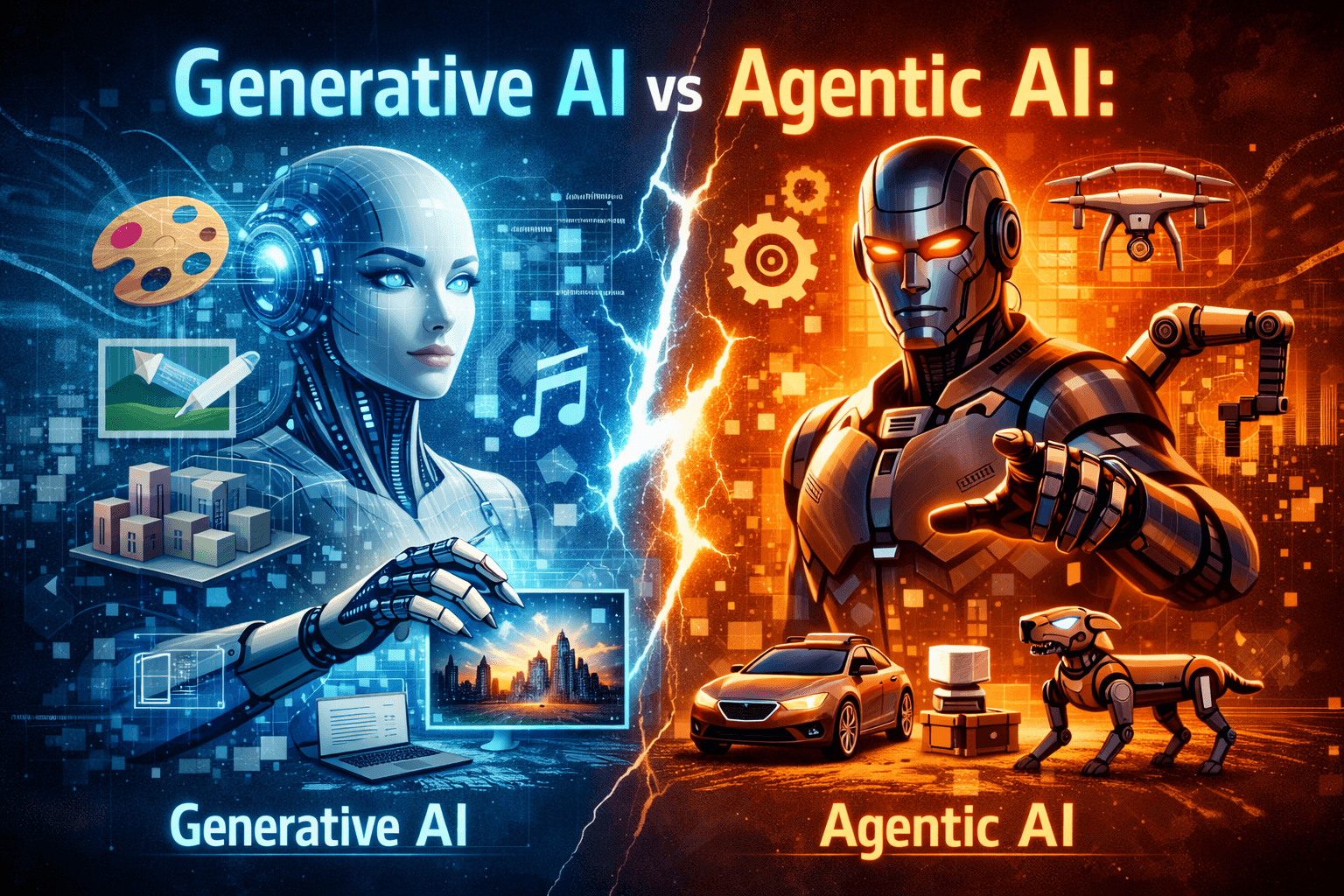
Native vs Hybrid App Development
The complete engineering comparison covering performance, market share, retention, security, architecture, and cost.
1Introduction: The Real Battle — Native vs Hybrid
Mobile app development has evolved dramatically over the past decade. What started as simple platform-specific development has transformed into a strategic engineering decision that directly impacts product scalability, user retention, security, and long-term cost.
At its core, the Native vs Hybrid debate is not about which technology is 'better.' It is about which architecture aligns with your business goals, technical complexity, performance expectations, and market strategy.
📊Market Reality: Why This Choice Matters
Android dominates the global smartphone market with approximately 86% share, while iOS holds around 12%. This means businesses targeting global markets often prioritize Android, whereas premium-market apps focus more on iOS.
If you build Native apps, you often need two separate teams for Android and iOS. Hybrid promises one codebase — but this promise comes with architectural trade-offs.
User Experience & Retention Statistics
79%of users will retry an app only once or twice if it fails to work properly the first time
1/4One in four users open an app only once and never return
Native apps generally outperform Hybrid apps in animation smoothness, responsiveness, offline behavior, and checkout flows — directly impacting retention and lifetime value.
Strategic Framing: It's Not Just Technology
The debate is ultimately about:
There is no universal winner. The correct choice depends entirely on product vision and execution strategy.
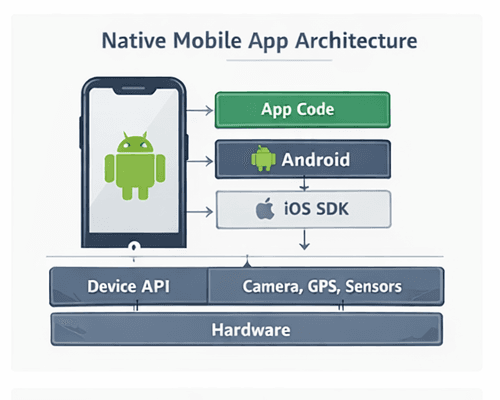
2Native Development: Deep Dive
Native Development
Building using official SDKs — Google for Android, Apple for iOS
Android Development
- →Languages: Java / Kotlin
- →IDE: Android Studio
- →UI: XML layouts, Jetpack Compose
iOS Development
- →Languages: Swift / Objective-C
- →IDE: Xcode
- →UI: Storyboards, SwiftUI
Key Advantages
- ✓Direct hardware API access
- ✓Platform-optimized UI rendering
- ✓Best performance for complex apps
- ✓Immediate OS feature adoption
3Hybrid Development: Cross-Platform Approach
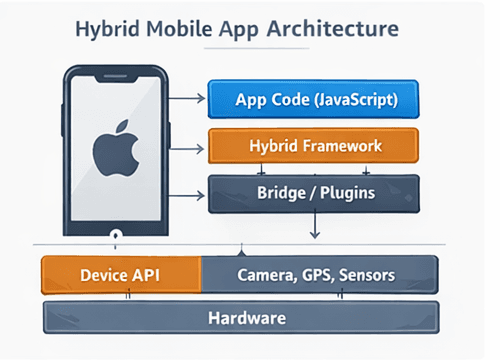
Hybrid Development
Third-party frameworks for cross-platform development
Popular Frameworks
- →React Native: JavaScript, bridge-based rendering
- →Flutter: Dart, engine-based rendering
- →Ionic: Web technologies, Capacitor
- →Xamarin: C#, .NET framework
Core Characteristics
- →Shared UI layer across platforms
- →Bridge/engine-based rendering
- →Single codebase maintenance
- →Plugin ecosystem for hardware
Advantages
- ✓Lower development cost
- ✓Faster time-to-market
- ✓Code reuse across platforms
Considerations
- ⚠️Bridge communication overhead
- ⚠️Plugin dependency
- ⚠️Framework update lag
4Global Smartphone Market Share Reality
Android controls approximately 86% of the worldwide smartphone market. iOS holds around 12%, primarily in premium and high-income markets.
Android
86%- ✓Dominates emerging & global markets
- ✓Wider device fragmentation
- ✓Large user base = volume strategy
- ✓Higher price sensitivity regions
iOS
12%- ✓Premium & high-income markets
- ✓Higher ARPU
- ✓Lower device fragmentation
- ✓Strong ecosystem loyalty
Strategic Implication
If your target market is global mass adoption, Android-first strategy may be prioritized. However, if you are targeting high-value customers, fintech users, or premium audiences, iOS often generates higher revenue per user.
Hybrid frameworks become attractive — enabling simultaneous deployment to both ecosystems without doubling development cost.
5Built-in Features & Hardware Access
Native Built-in Access
- ✓Direct camera, GPS, Bluetooth, NFC access
- ✓Biometric authentication (Face ID / Fingerprint)
- ✓Unlimited background processing
- ✓Advanced push notification customization
- ✓Encrypted local databases
- ✓Better battery optimization
Hybrid Built-in Access
- →Access via plugins or bridge modules
- →Community-maintained packages
- →Possible lag in OS feature support
- →Limited system-level customization
- →Extra layer for secure storage
- →Performance varies by framework
Hardware & Feature Depth Comparison
6Security Analysis
Native Security Strengths
- 🔒Direct OS-level encryption APIs
- 🔒Stronger code obfuscation
- 🔒Secure Keychain/Keystore
- 🔒Lower third-party risk
Hybrid Security Considerations
- ⚠️Plugin-based hardware access
- ⚠️Bridge module dependencies
- ⚠️Third-party vulnerabilities
- ⚠️Extra abstraction layer
Regulatory & Compliance Considerations
| Standard | Native | Hybrid |
|---|---|---|
| PCI-DSS (Payments) | Full encryption control & secure keystore | Possible with secure plugin integration |
| HIPAA (Healthcare) | Better OS-level data isolation | Requires strict dependency audits |
| GDPR (Data Privacy) | Strong local data encryption | Achievable with secure API handling |
| SOC 2 | Infrastructure dependent, easier control | Framework security posture matters |
| ISO 27001 | Supported via secure architecture | Requires controlled plugin usage |
For high-security domains such as fintech, healthcare, or government applications, Native development provides tighter system-level control. Hybrid apps remain secure when properly implemented, but require additional dependency audits and security testing.
7User Experience & Retention
Studies show that 79% of users retry an app only once or twice if it fails initially, and one in four users abandon an app after the first use.
Native UX Advantages
- ✓Smoother animations
- ✓Platform-specific design
- ✓Better gesture handling
- ✓Faster checkout flow
Hybrid UX Considerations
- →Shared UI layer
- →May lack native feel
- →Animation varies by framework
- →Design compromise
Retention Impact
Native apps typically deliver stronger retention in performance-heavy or transaction-critical products. Hybrid apps perform well for content and business-driven applications where speed-to-market is prioritized.
8Cost Comparison
Native Cost Structure
- 💰Separate Android & iOS teams
- 💰Higher QA & testing effort
- 💰Longer release cycles
- 💰Higher long-term scalability value
Hybrid Cost Structure
- 📉Single shared codebase
- 📉Reduced development duplication
- 📉Faster MVP launch
- 📉Lower initial investment (30–45% savings)
Estimated Relative Development Investment
Hybrid development reduces initial investment and speeds up time-to-market. Native development demands higher upfront cost but offers long-term architectural stability and maximum performance headroom.
9Final Strategic Verdict
Native wins in performance, security, and deep hardware access. Hybrid wins in cost efficiency and development speed.
The right choice depends entirely on your business goals, target audience, and technical requirements.
- • Performance is critical
- • Hardware-intensive features
- • Maximum security required
- • Long-term scalability
- • Fast MVP needed
- • Limited budget
- • Content-driven apps
- • Simple business logic

QodeNexus Engineering Team
Senior Mobile Architects with 5+ years of experience in native and cross-platform development. We've built apps for Fortune 10 companies and high-growth startups.